
· Tess Brandow
How to keep bread fresh
Almost every piece of bread-storage advice you have heard assumes bread goes hard because it dries out. It does not, and once you know that, half the advice sorts itself into the bin. Here is the mechanism, and then the short list of things that actually follow from it.
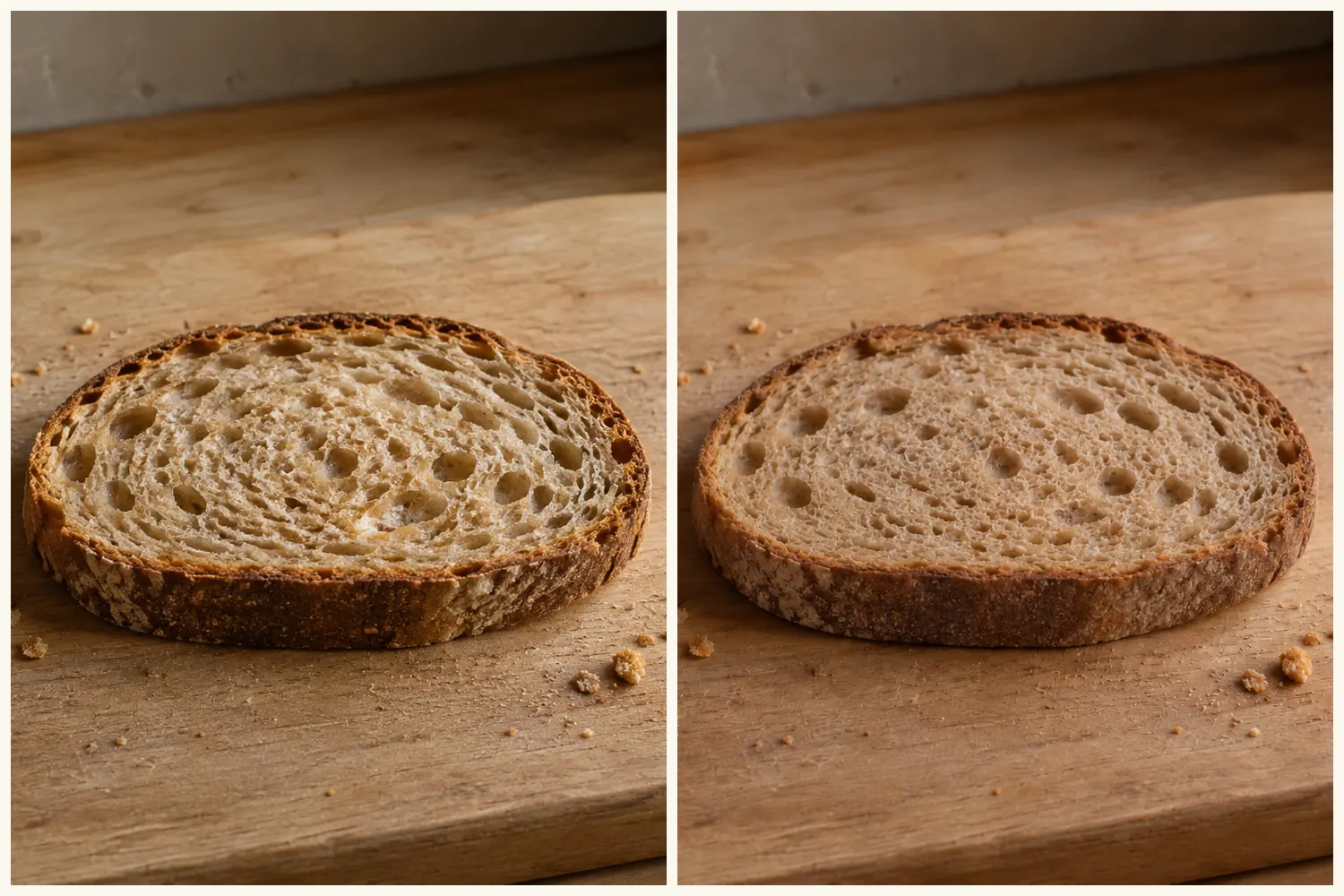
The mechanism, in one paragraph
When dough bakes, starch granules absorb water and swell — they gelatinise. As the loaf cools and then sits, those starch molecules slowly rearrange themselves back into an ordered, crystalline form, and in doing so they squeeze out the water they were holding. The water is still in the loaf. It has just moved somewhere the crumb cannot use, and the crumb feels dry and firm as a result. The name for this is retrogradation.
What follows from it
Temperature matters more than wrapping. Retrogradation is fastest in the cold, short of freezing. A loaf in the fridge firms up faster than the same loaf on the counter, whatever either is wrapped in. Below freezing, the process stops.
Wrapping still matters, for a second reason. The crumb does also lose some water to the air, on top of what the starch takes. A breathable wrapping slows that without trapping steam against the crust. That is the whole case for a cloth bag over a plastic one.
Heat undoes it, temporarily. Warm the loaf to around 60 °C and the crystals melt back. That is why a stale loaf in a hot oven comes back to life for an hour. It also stales faster afterwards, so reheat what you are about to eat, not the whole loaf.
The short list that works
- Cool the loaf completely before it goes anywhere.
- Keep it at room temperature for two to three days, cut side down, in something that breathes.
- Freeze in slices, on baking day, anything you will not get through.
- Refresh in a hot oven, once, just before eating.
The wrappings already in your drawer
Most people reach for something they already own before they buy anything, so it is worth knowing what each of those does to a loaf. All four of these seal to some degree, which is the property that decides the outcome.
| Wrapping | What it does to the loaf | When it earns its place |
|---|---|---|
| Cling film | Seals completely; the crust softens overnight and moisture collects against it | A cut cake or an enriched loaf with no crust to lose |
| Aluminium foil | Seals almost as well, and holds the loaf’s shape while it does | Reheating a loaf in the oven, not storing it afterwards |
| Freezer bag | Seals; in the freezer that is exactly right, on the counter it is not | Sliced bread going into the freezer on baking day |
| Paper bag | Breathes freely, so the crust holds and the crumb dries out fast | A crusty loaf you will finish within the day |
The pattern is consistent: the sealed options protect the crumb and sacrifice the crust, and the paper bag does the reverse. A close woven cloth sits between the two, which is the only place a loaf with a crust and a soft crumb can be kept without giving one of them up.
One combination is worth knowing about because it genuinely works: paper inside cloth. A loaf in a paper bag inside a woven bag keeps a little longer than either alone, because the paper takes the last of the steam off the crust while the cloth slows the air outside it. It is fiddly, and it is what I do with a loaf I care about on a Friday.
If you only change one thing
These habits are not worth the same. Ranked by how much difference each one makes to a home-baked loaf: take it out of the fridge, cool it fully before it goes into anything, stand it on its cut face, and only then worry about what the bag is made of. The wrapping is the last of the four, not the first, and a loaf on a board under a cloth beats the same loaf sealed in the cold whatever the cloth is.
The folklore, and why it fails
An apple or a potato in the bread bin. This adds humidity. Humidity does not slow retrogradation; it softens the crust and shortens the time to mould.
A tea towel alone. Better than nothing and better than plastic, but it lets far more air across the loaf than a closed bag does. It suits a loaf you will finish today.
The fridge, for mould. The reasoning is sound — cold does slow mould — but the cost is a loaf that is hard before it would ever have gone mouldy. If mould is the real worry, the freezer solves it without the penalty.
Cutting from the middle and pushing the halves together. A genuinely old trick, and it does protect two cut faces. It also gives you two awkward half loaves. Standing one loaf on its cut face achieves the same thing.

Tess Brandow · Home baker — she writes the guides on this site
Tess has baked the household’s bread for about fifteen years, two loaves most weeks, in an ordinary kitchen with an ordinary oven. She is not a professional baker and does not run a bakery. What she has is a long run of the same problem: a loaf that is worth eating on Monday and disappointing by Wednesday.