
· Tess Brandow
How to store sourdough bread
Sourdough is the loaf that punishes bad storage hardest. It has the crust that plastic ruins and the open crumb that bare air dries out, so the two easy answers — bag it or leave it — are both wrong in different directions. What follows is what actually works, in the order the loaf ages.
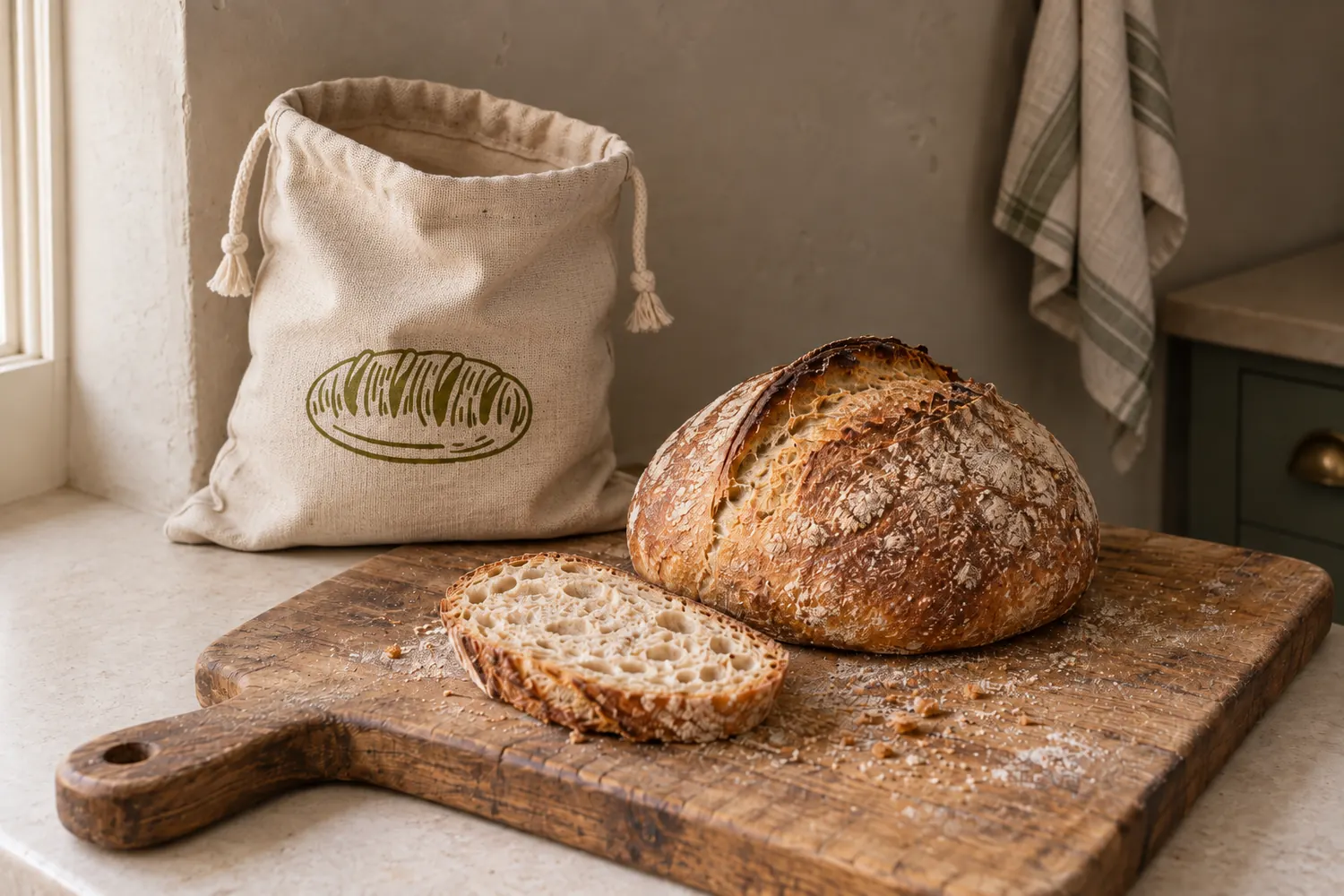
Day one: leave the crust alone
A loaf out of the oven is still cooking. The crumb is setting, and steam is still leaving through the crust for an hour or more. Bagging it in that window is the single most common way to ruin a good bake — the steam has nowhere to go, condenses against the crust, and by evening the crackle you listened for is gone.
So the first rule is a waiting rule. Cool the loaf completely on a rack, uncovered, for at least two hours. A dense rye or a large boule wants longer. Only then does storage begin.
Day one to three: cut side down, bag over the top
Once you cut into a loaf, you have opened it. The cut face is the only part with no crust protecting it, and it is where the crumb dries from. Standing the loaf on that face, flat against a wooden board, closes it against the board and turns the crust into the lid it was meant to be.
The cloth bag goes over the whole thing. It is not there to seal — it is there to slow the air moving across the loaf while still letting the last of the steam out. A close weave does both. A plastic bag does only the first, and softens the crust as its fee.
Why the fridge makes it worse
Bread does not go stale by drying out. The starch in the crumb recrystallises after baking and squeezes water out of its own structure, so the crumb turns firm while the water is still inside the loaf. That process is temperature-dependent, and it runs quickest in the cold. Research on storage temperature and starch retrogradation finds that bread held at fridge temperature develops more ordered starch crystals than bread held in a freezer.
In a kitchen, that shows up as a loaf that is noticeably harder after one cold night than after two on the counter. The fridge is the right answer for almost everything else you own and the wrong answer for bread.
A sourdough loaf, day by day
The same loaf wants different handling on Monday and on Thursday. This is the whole routine in one place.
| When | What the loaf is doing | What to do |
|---|---|---|
| Out of the oven | Still cooking; the crumb is setting and steam is leaving through the crust | Cool it on a rack, uncovered, at least two hours. Longer for a dense rye or a large boule. |
| Day one, uncut | Sealed by its own crust; losing very little | Leave it on the board under the cloth bag. It needs almost nothing from you. |
| Day one, once cut | The cut face is open and dries first | Stand it on the cut face against the wood, bag over the top. |
| Days two to three | Starch recrystallising; crumb firming from the inside | Same routine. Toast the slices if the crumb has tightened. |
| Day four and beyond | Firm throughout, crust dulled, still perfectly safe | Refresh in a hot oven before a meal, or turn it into croutons and crumbs. |
| Anything you will not reach | Nothing yet — act before it starts | Slice and freeze on baking day, not on the day it goes hard. |
The line that costs people most is the first one. A loaf bagged while it is still warm sweats inside the cloth, and a sweating loaf moulds in half the time it otherwise would. Two hours of patience on a rack buys two days at the other end.
Past day three: slice it and freeze it
Freezing is the one storage method that stops staling instead of slowing it, because below freezing the starch cannot recrystallise. The trick is to slice first. A whole frozen loaf has to thaw completely before you can do anything with it, and thawing takes it back through the cold band where it stales. Slices go from the freezer straight into the toaster.
Freeze the slices flat on a tray, then bag them once solid so they do not fuse into a block. A loaf frozen on the day it was baked comes back closer to fresh than a two-day-old loaf ever will.
Reviving a loaf that has gone firm
Retrogradation is reversible with heat. A loaf that has firmed up on the counter will soften again at around 60 °C — run the crust briefly under the tap, then ten minutes in a hot oven. It is genuinely good again for an hour or two, after which it stales faster than before. Do it once, and do it just before a meal.
What not to bother with
A cut lemon, an apple slice, a stick of celery in the bag: all of these add moisture to the air around the loaf, which softens the crust and does nothing about the starch. They are folklore for a different problem, keeping cake moist, and they make bread worse.

Tess Brandow · Home baker — she writes the guides on this site
Tess has baked the household’s bread for about fifteen years, two loaves most weeks, in an ordinary kitchen with an ordinary oven. She is not a professional baker and does not run a bakery. What she has is a long run of the same problem: a loaf that is worth eating on Monday and disappointing by Wednesday.