
· Tess Brandow
How long does bread last in a bread bag?
The answer is a range, because the loaf decides more than the bag does. A high-hydration sourdough and a lean white tin loaf age at visibly different rates in the same cloth on the same counter. What follows is the range I actually get, what moves it, and how to tell the difference between a loaf that has gone firm and one that has gone off.
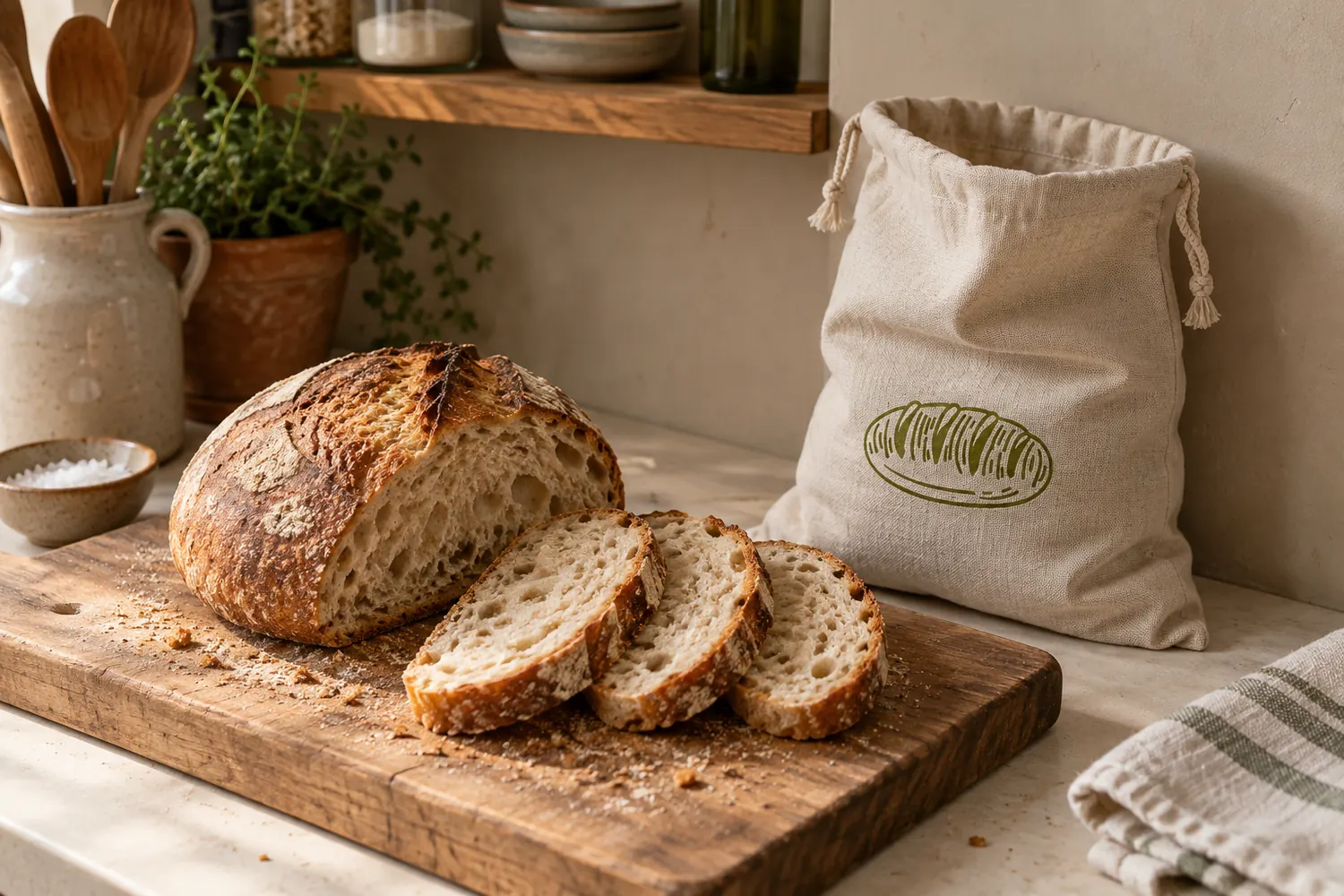
The range, by loaf
Days here mean days the bread is still worth eating as bread — not the day it becomes inedible, which is much later, and not the day it stops being perfect, which is the afternoon it came out of the oven.
| Loaf | Counter, woven bag | Counter, unwrapped | Freezer, sliced |
|---|---|---|---|
| Lean white or wheat tin loaf | 2–3 days | About a day and a half | 3 months |
| Sourdough boule, high hydration | 3–4 days | 2 days | 3 months |
| Rye or wholemeal | 3–4 days | 2 days | 3 months |
| Enriched dough with milk, butter or egg | 3–4 days, then mould | 2 days | 2 months |
| Baguette or thin crusty roll | Hours, not days | Hours | 1 month, refreshed in the oven |
| Shop sandwich loaf with preservatives | 5–7 days | 3–4 days | 3 months |
The last row is worth dwelling on, because it is the comparison most people are making without realising it. A supermarket loaf contains emulsifiers and enzymes whose entire job is to delay the crumb firming up. They work. If your home-baked bread seems to age fast, it is not a fault in your recipe — it is the absence of those additives.
What moves the number
Water in the crumb. More hydration means more water to lose before the loaf reads as dry, which is why a wet sourdough outlasts a lean tin loaf by roughly a day. Rye holds water particularly well.
How much crust there is. Crust is the loaf’s own barrier. A large boule with a thick bake has a small surface area relative to its volume and keeps well. A baguette is nearly all crust and surface, and it is finished the same evening — that is the nature of the shape, not a storage failure.
Fat and sugar. Butter, milk and egg slow staling and soften the crumb, so an enriched loaf stays tender longer. They also feed mould, so the loaf goes from good to fuzzy without the long stale phase in between.
The kitchen itself. A warm kitchen speeds up mould and a cold one speeds up staling, because starch recrystallises fastest just above freezing. A room at about 20 °C is the compromise, which is convenient, because that is where most kitchens sit.
Whether the loaf is cut. A whole loaf is sealed by its own crust. The moment you cut it, you have opened a face with no protection, and that face dries first. Standing the loaf on the cut side against a wooden board closes it again, and is the single habit that makes the most difference to a half loaf.
What the bag is actually buying you
A woven bag is doing two jobs that pull against each other. It slows the air moving across the loaf, so the crumb keeps its moisture. And it lets the loaf’s own steam leave, so that steam does not condense on the crust and soften it. Plastic does the first and fails the second; open air does the second and fails the first. The mechanism behind all of this is in our guide on how to keep bread fresh, and the cloth itself is covered in what the cloth has to do.
In practice the bag roughly doubles the useful life of a cut home-baked loaf at room temperature. It is a real gain, and it is a modest one. Anyone promising a week on the counter for a loaf with no preservatives in it is describing a different loaf.
What shortens it
Bagging the loaf warm. The most common and most expensive mistake. A loaf that is still giving off steam will sweat inside any bag, and a sweating loaf moulds in half the time. Cool it completely on a rack first — two hours for an ordinary loaf, longer for a dense rye.
The fridge. Research on storage temperature and starch retrogradation finds that bread held at fridge temperature develops more ordered starch crystals than bread held in a freezer.1 In a kitchen that shows up as a loaf noticeably harder after one cold night than after two on the counter.
Sealing it. A zip, a clip or a knot that closes the bag airtight turns a cloth bag into an expensive plastic one. A drawstring is meant to gather, not to seal.
A dirty bag. Old crumbs and a trace of butter in the weave are where mould starts. The bag goes in the wash with the tea towels; skip the softener, which coats the threads and closes the weave.
Stale is not the same as spoiled
These two get confused constantly, and they call for opposite responses. Stale bread is perfectly safe and can be brought back. Mouldy bread goes out, all of it.
| What you see | What it is | What to do |
|---|---|---|
| Crumb firm and dry to the touch, smell still good | Staling — starch has recrystallised | Warm it through in a hot oven, or use it for toast |
| Crust soft and slightly leathery | Moisture trapped against the crust | Five minutes in a hot oven brings the crackle back |
| Any fuzzy spot, green, white or black | Mould, and its threads run through the loaf | Throw the whole loaf away, cutting round it is not enough |
| Sour or alcoholic smell with no visible growth | Yeast or bacterial activity | Throw it away |
| Pink, orange or sticky patches | Bacterial spoilage | Throw it away and wash the bag hot |
The one rule worth memorising: staling is reversible with heat, spoilage is not reversible with anything. A loaf that has gone firm on Wednesday is a loaf for toast, croutons or a hot oven. A loaf with a spot of fuzz on it is finished, however small the spot looks.
Getting more days out of the same loaf
Freeze on baking day rather than when the loaf starts to go hard. Freezing stops staling where it stands; it does not undo what has already happened, so a loaf frozen fresh comes back much closer to fresh than one frozen on day three. Slice first, freeze the slices flat on a tray, bag them once solid so they do not fuse, and toast them from frozen.
For the loaf on the counter, the routine is short: cool it completely, stand it on its cut face on a board, bag over the top, and leave it at room temperature. That is the whole method, and it is set out loaf by loaf in our guides to storing sourdough and storing homemade bread.
1. Foods, “Influence of Storage Temperature on Starch Retrogradation and Digestion of Steamed Bread”, 2024.

Tess Brandow · Home baker — she writes the guides on this site
Tess has baked the household’s bread for about fifteen years, two loaves most weeks, in an ordinary kitchen with an ordinary oven. She is not a professional baker and does not run a bakery. What she has is a long run of the same problem: a loaf that is worth eating on Monday and disappointing by Wednesday.